| Table of Contents |
| Introduction |
| Performing the Perfect Self Nosedive and Digital Personas |
| Public Breakdown Goffman, Identity Collapse, and Emotional Labour |
| Free Guy AI Awareness, Creativity, and the Question of Personhood |
| Mad Max Fear, Scarcity, and Power in a Ruined World |
| Alita and the Meaning of Humanity Cyborg Bodies, Emotion, and Posthuman Identity |
| Peer Replies Evidence of Active Participation |
| How These Discussions Shaped My Podcast: The Eden Project |
| Conclusion Seeing Futures Through Film and Conversation |
| References |
Throughout BCM325, the weekly Discord screenings pushed me into a mode of thinking I wasn’t used to analysing films as events. This real-time commentary allowed me to apply futures theory more naturally, connecting ideas about identity, surveillance, emotional labour, and society to the films we studied. What began as quick reactions developed into deeper reflections on how imagined futures mirror the behaviours, pressures, and technologies shaping our present.
This reflection brings together five of my strongest Discord posts, two replies, and a discussion on how these analyses directly influenced the creation of my speculative podcast, The Eden Project.
1.Performing the Perfect Self Nosedive and Digital Personas
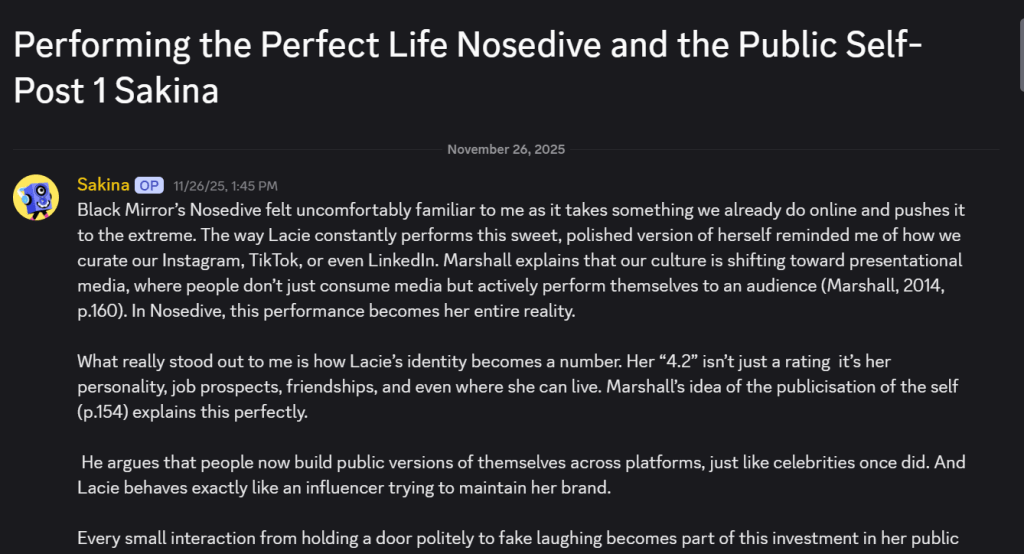
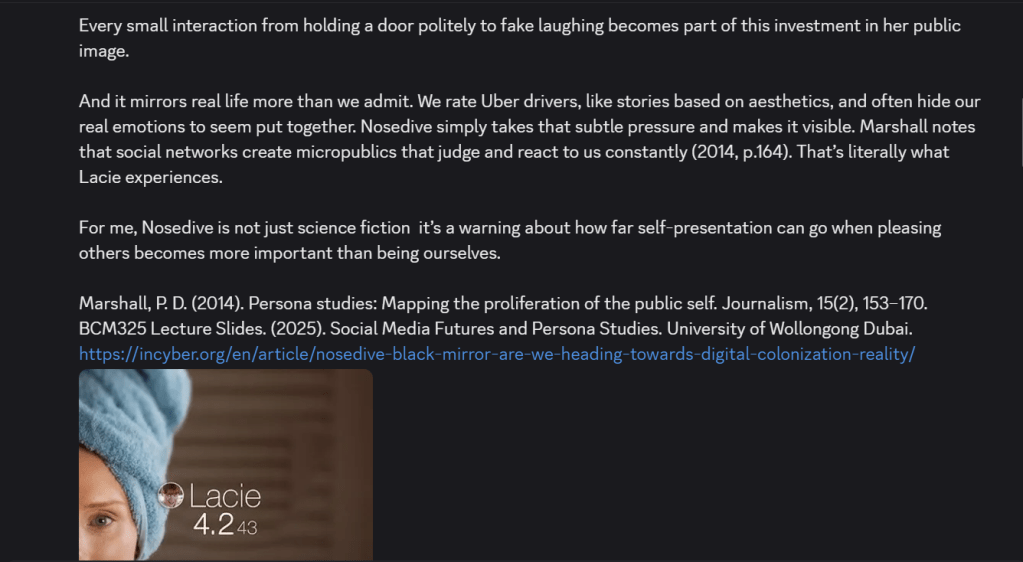
In my first major contribution on Nosedive, I applied Marshall’s (2014) concept of presentational media, which explains how individuals curate selected aspects of themselves for specific audiences. Lacie’s constant self-management rehearsing smiles, controlling tone, and maintaining “pleasantness” reflects the emotional labour demanded by algorithmic systems that reward likeability and conformity.
This helped me understand a central aspect of futures thinking: identity becomes a managed performance, and platforms reinforce these performances through validation systems (Marshall, 2014). The exaggerated world of Nosedive highlights a reality that already exists we perform online identities daily, negotiating between authenticity and what is socially rewarded.
2.Public Breakdown Goffman, Identity Collapse, and Emotional Labour
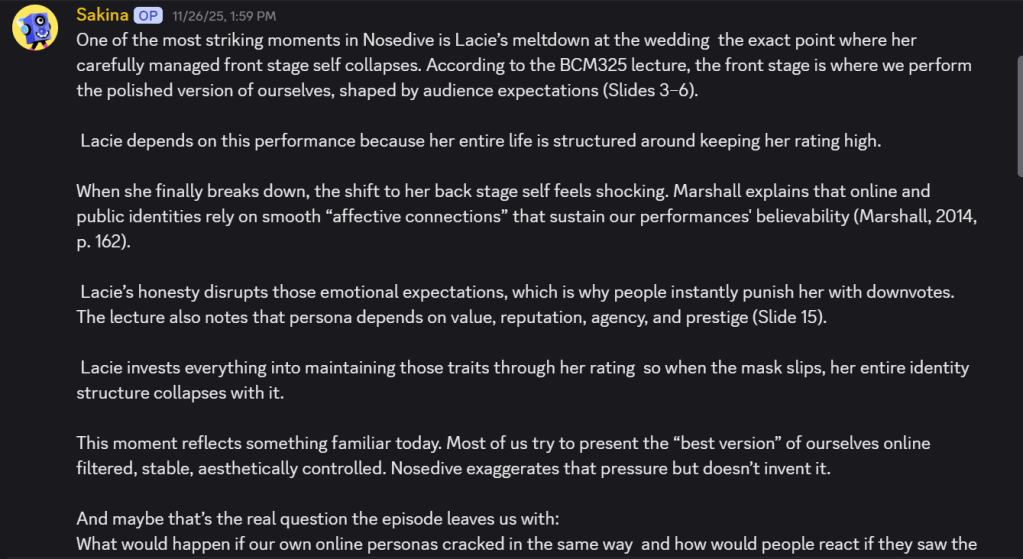
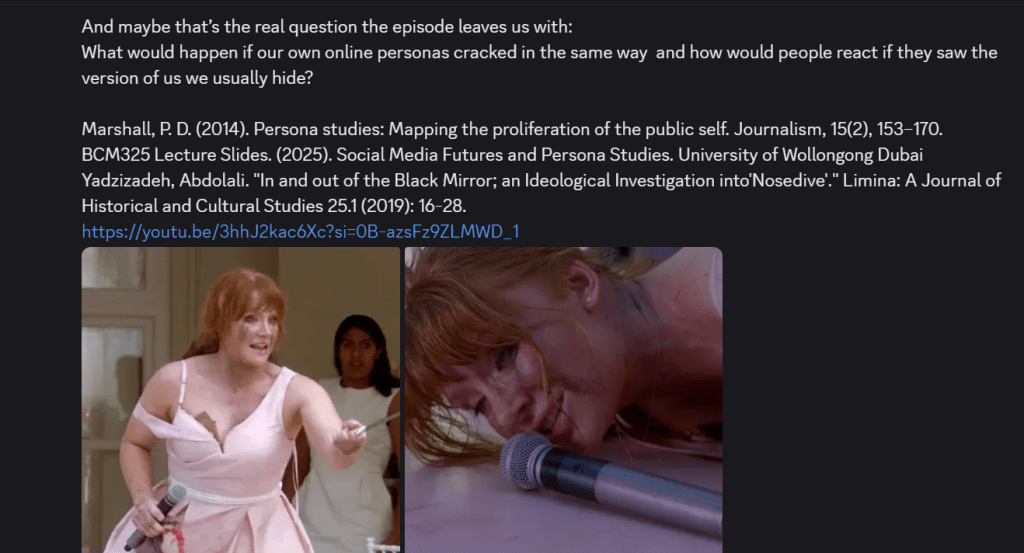
My second post analysed Lacie’s breakdown during the wedding speech using Goffman’s (1959) front-stage/back-stage framework. Her collapse represents a moment where the persona she has constructed can no longer be maintained under pressure.
This scene illustrates how emotional labour becomes a mechanism of control in speculative futures. Systems do not always need physical enforcement individuals internalise expectations and regulate themselves accordingly. Recognising this helped me see that dystopias often emerge from participation, not coercion a theme reinforced repeatedly throughout BCM325.
3.Free Guy AI Awareness, Creativity, and the Question of Personhood
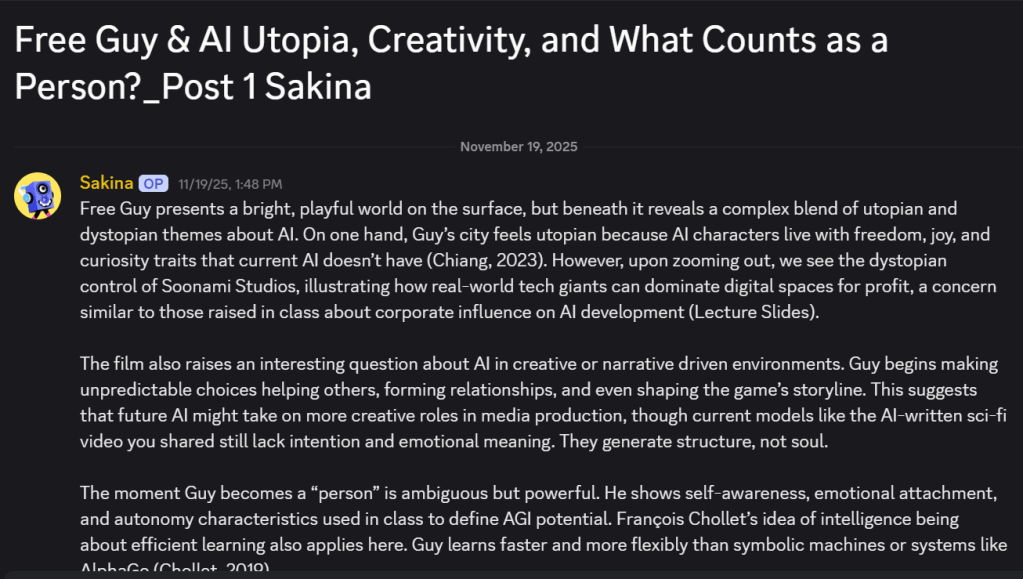
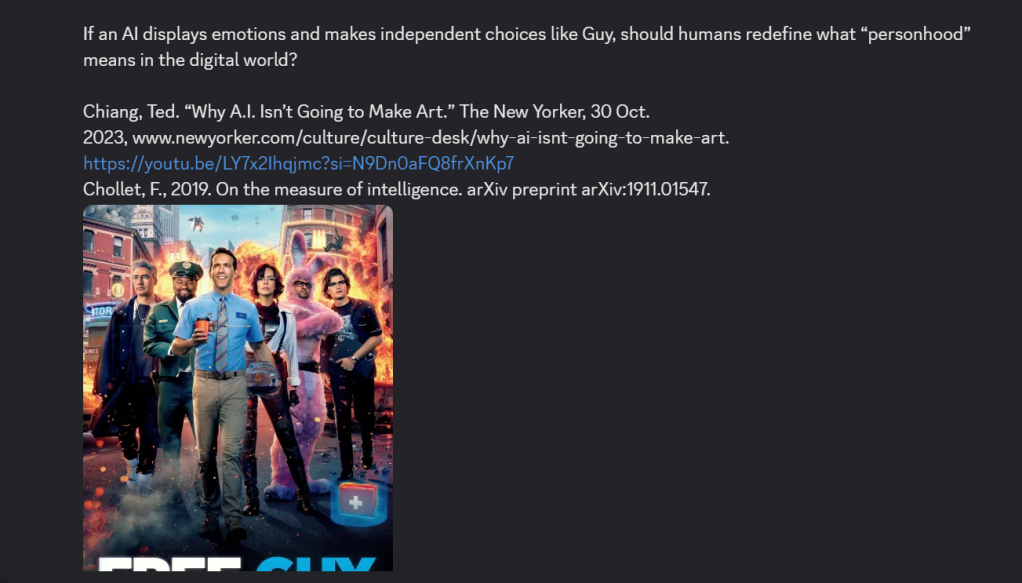
In my analysis of Free Guy, I connected the film to Chiang’s (2019) ideas about truth and perception, and Chollet’s (2019) argument that AI often imitates rather than originates. Guy’s sudden desire for the “sunglasses” symbolises a shift from programmed behaviour to what appears as emergent intention.
This raised critical questions about the boundary between pattern recognition and creativity. Although real AI cannot “want” or “feel,” Free Guy exaggerates the possibility to explore the future implications of emotional simulation. Writing this post encouraged me to approach futures thinking through uncertainty, focusing on possibilities rather than predictions (Chiang, 2019).
4. Mad Max Fear, Scarcity, and Power in a Ruined World
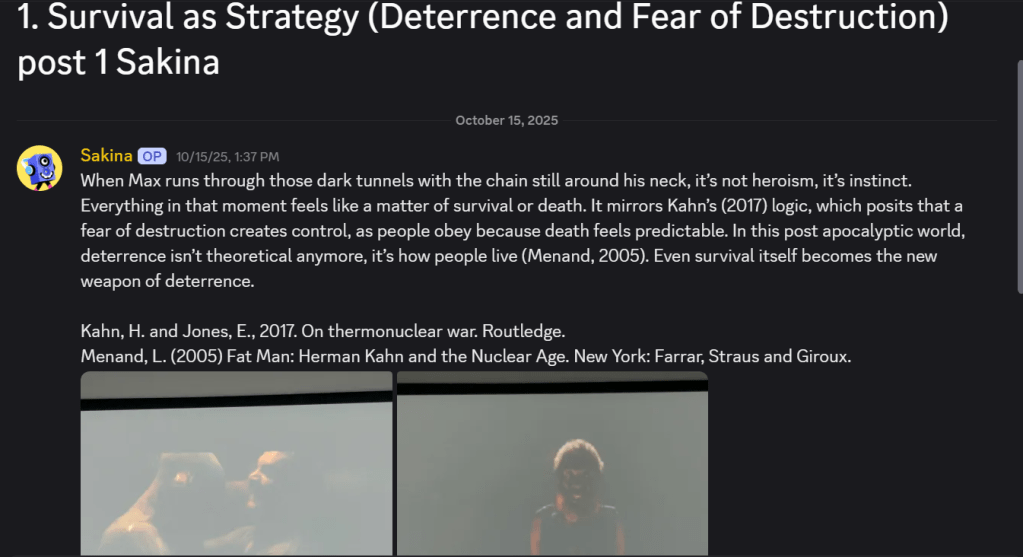
Here, I drew on Menand’s (2005) discussion of Kahn’s (1960) deterrence logic to interpret Mad Max as a system where scarcity and fear replace digital surveillance. Instead of algorithmic control, the world regulates behaviour through the immediacy of danger, deprivation, and desperation.
This helped me understand how different futures employ different mechanisms of power. Advanced technology is not always the defining factor. Sometimes environmental collapse or resource scarcity becomes the primary tool of control. This broadened my understanding of speculative futures and enriched the range of themes I engaged with throughout the semester.
5.Alita and the Meaning of Humanity Cyborg Bodies, Emotion, and Posthuman Identity
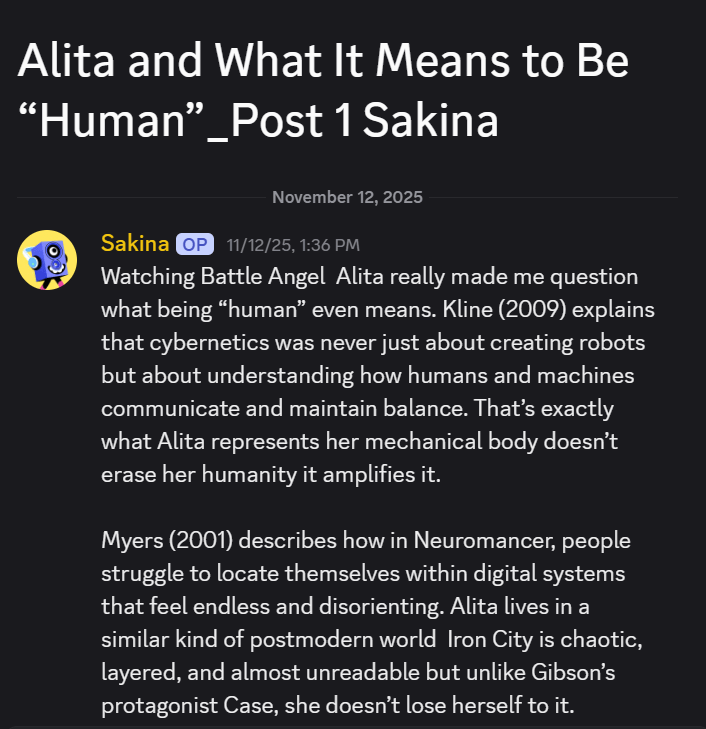
For my fifth major post, I analysed Alita: Battle Angel through the lens of cybernetics, posthumanism, and emotional identity. I drew on Kline’s (2009) argument that cybernetics is not simply about building machines, but about understanding the relationship between humans and technology. This helped me see Alita differently: her mechanical body does not diminish her humanity it intensifies it.
I also connected the film to Myers’ (2001) reading of Neuromancer, where people struggle to locate themselves within endless digital systems. Iron City mirrors that disorientation, yet unlike Gibson’s protagonist, Alita does not lose herself within technological chaos. Instead, she finds purpose through emotion, memory, and connection.
This post raised an important question for me:
If technology can imitate logic, language, and behaviour, are emotions the last remaining marker of humanity?
Peer Replies Evidence of Active Participation
Reply 1 – Expanding on Emotion and Consciousness
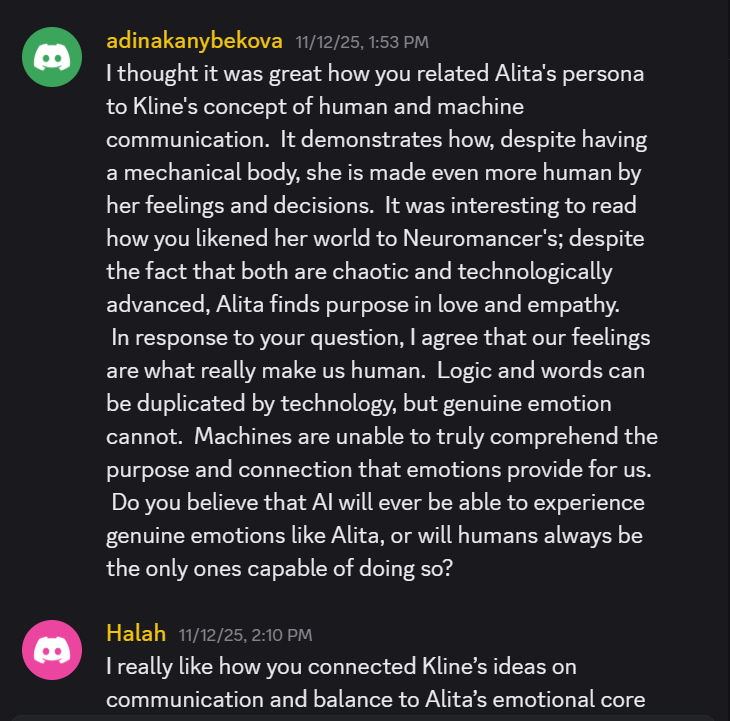
A classmate expanded on my point by arguing that genuine emotion is what separates humans from machines. In response, I reflected that although AI can mimic emotional expression, it cannot experience emotion the way humans do. I wrote about how Alita’s emotional responses make her feel real: her memories, attachments, and losses shape her identity in ways AI cannot genuinely replicate.
I concluded that imitation is not experience, and this distinction may be the boundary between consciousness and programming a key theme in cyberpunk futures (Kline, 2009).
Reply 2 – Emotional Identity vs. AI Simulation
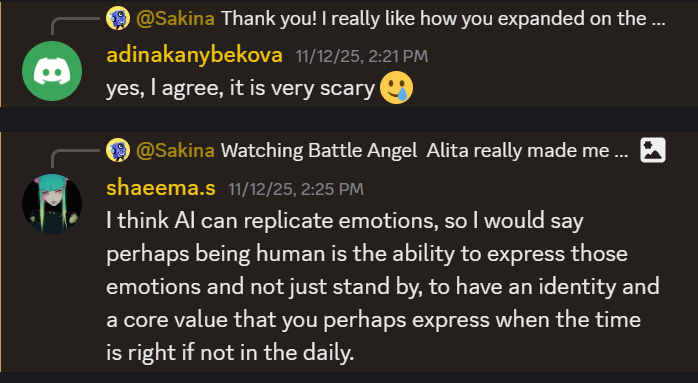
Another peer argued that AI may express emotions in the future. I agreed possibilities exist, but maintained that emotional authenticity comes from lived experience something AI cannot access. This reply allowed me to critically reflect on how close current technology already is to simulating human behaviour, even without true understanding.
Reply 3: Curiosity and Identity Expansion
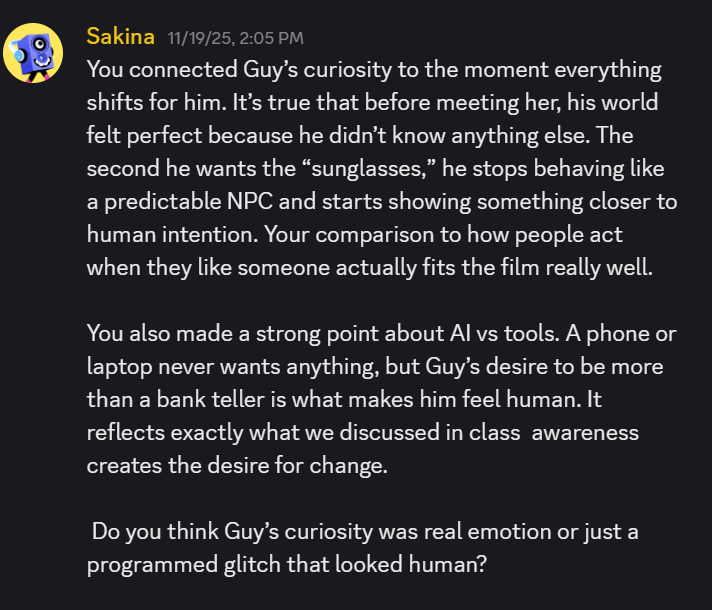
In this reply, I expanded on a peer’s point by connecting Guy’s curiosity to human motivation. I argued that his desire to understand the sunglasses resembles how people shift behaviour when something emotionally significant disrupts routine.
Reply 4: Are We Becoming Too Dependent on AI?
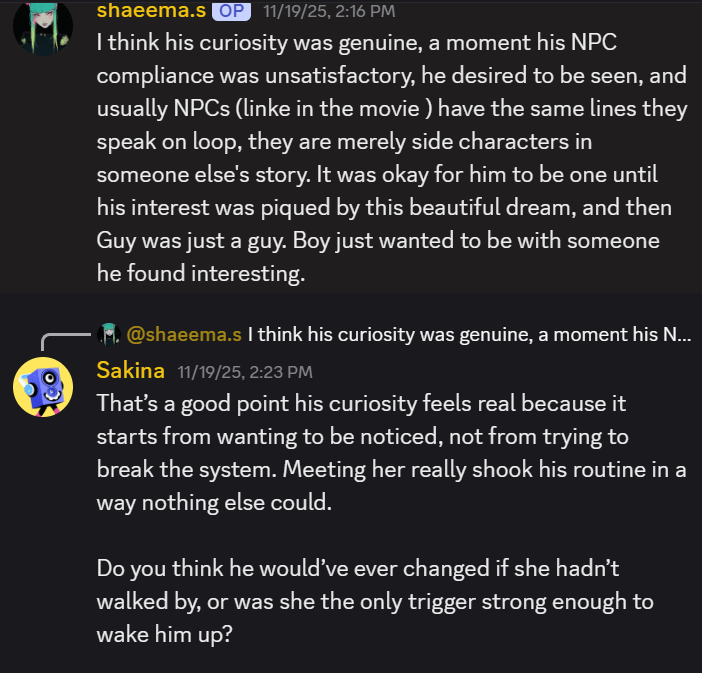
Here, I responded to a question about AI dependence. I suggested that although we rely on AI tools, we are not yet at the existential stage imagined in the film. This helped me recognise the gap between cinematic exaggeration and realistic technological futures.
Reflection on Podcast Creation, Scriptwriting, and Learning to Edit: The Eden Project
The weekly discussions didn’t just deepen my understanding of futures theory they shaped the entire creative direction of my podcast.
Working on The Eden Project as a group became one of the most transformative parts of the subject. Even though I wasn’t the main editor, I learned so much by watching my group refine sound layers, adjust pacing, and build atmosphere through audio. Seeing how many small elements go into the editing process from selecting ambient tones to placing footsteps or adjusting silence made me appreciate sound as a storytelling tool rather than just a technical requirement. By the middle of the project, I realised how much the films we analysed in class shaped my creative decisions.
Movies like Nosedive, Alita, Free Guy, and Mad Max taught me to think about sound from multiple angles: how glitches communicate memory loss, how hums signal surveillance, how silence builds suspense, and how footsteps signal agency or fear. When we began drafting Scripts 3 and 4, I found myself drawing directly from these ideas. The writing felt “inspired on the go,” but it was really informed by weeks of analysing soundscapes, emotional beats, and world-building techniques in class.
Looking back now, seeing where I started and where the podcast ended gives me a real sense of growth. I didn’t just learn how to write a speculative story I learned how to hear it, interpret it, and build it. Understanding how sound, script, and theory come together was one of the most rewarding parts of this project, and it showed me how much futures thinking can shape creative storytelling.
Conclusion Seeing Futures Through Film and Conversation
Engaging in live Discord analysis transformed how I understand speculative futures. Each post, reply, and discussion strengthened my ability to apply theory in real time and recognise the deeper implications of filmic futures.
The themes that emerged identity performance, surveillance, simulation, AI behaviour, scarcity, and emotional labour became the foundation for my own project. The Eden Project grew directly from these reflections, combining theoretical insights with creative storytelling.
BCM325 ultimately taught me that futures are not simply imagined worlds. They are ongoing negotiations between people, institutions, technologies, and narratives. And through film, theory, and collaborative analysis, I learned how to critically participate in that process.
References
Baudrillard, J. (1994). Simulacra and simulation (S. F. Glaser, Trans.). University of Michigan Press.
(Original work published 1981)
Bentham, J. (1995). The panopticon writings (M. Božovič, Ed.). Verso.
Chiang, T. (2019). Exhalation: Stories. Alfred A. Knopf.
Chollet, F. (2019). On the measure of intelligence. ArXiv. https://arxiv.org/abs/1911.01547
Foucault, M. (1977). Discipline and punish: The birth of the prison (A. Sheridan, Trans.). Pantheon Books.
Myers, T. (2001). The postmodern imaginary in William Gibson’s Neuromancer. MFS Modern Fiction Studies, 47(4), 887-909.
Foucault, M. (2008). The birth of biopolitics: Lectures at the Collège de France, 1978–1979 (G. Burchell, Trans.). Palgrave Macmillan.
Goffman, E. (1959). The presentation of self in everyday life. Anchor Books.
Kahn, H. (1960). On thermonuclear war. Princeton University Press.
Marshall, P. D. (2014). Persona studies: Mapping the proliferation of the public self. Journalism, 15(2), 153-170.
Menand, L. (2005). Fat man: Herman Kahn and the nuclear age. The New Yorker.
Chiang, Ted. “Why A.I. Isn’t Going to Make Art.” The New Yorker, 30 Oct. 2023, http://www.newyorker.com/culture/culture-desk/why-ai-isnt-going-to-make-art.
https://youtu.be/LY7x2Ihqjmc?si=N9Dn0aFQ8frXnKp7 Chollet, F., 2019. On the measure of intelligence. arXiv preprint arXiv:1911.01547.
 making media