Individual Contribution: Concept Development, Media Logic, and Campaign Structure BCM 206
Misinformation in contemporary media environments is often framed as a problem of individual ignorance or poor media literacy. However, this project approaches misinformation as a networked condition, shaped by how information circulates across digital and physical systems. Context, Please. was developed as a media-based intervention that responds to how networks prioritise speed, visibility, and engagement over accuracy and context, influencing what people believe before they have time to reflect.
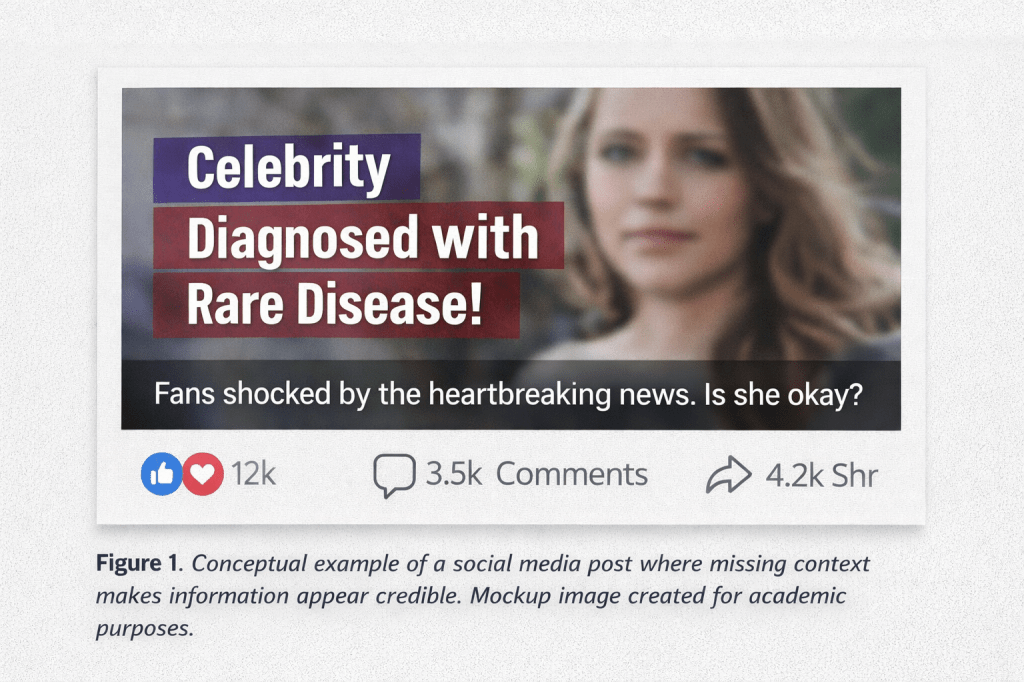
Rather than focusing on individual users, this project understands misinformation as a structural issue produced by media networks. Social media platforms reward content that generates immediate reactions such as likes, shares, and comments. As a result, emotionally charged, simplified, or sensational information spreads more easily than contextualised or carefully verified content. At scale, this system shapes collective beliefs and social behaviour, turning misinformation into a societal issue rather than an isolated misunderstanding (Wardle & Derakhshan, 2017; Vosoughi et al., 2018).
As the conceptual lead for Context Please., my role was to develop the campaign’s reasoning, structure, and media logic, ensuring that the response directly addressed the network conditions that enable misinformation. The central idea of the campaign is to expose how belief is often formed through first impressions and incomplete information, rather than through careful evaluation.
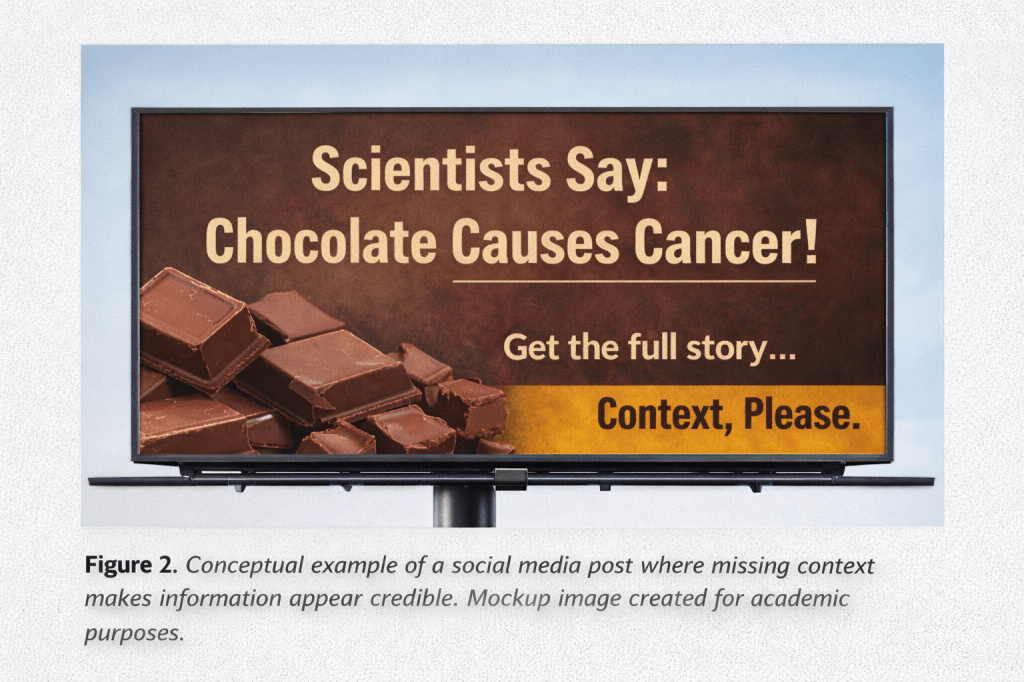
The campaign operates across multiple media environments, including Instagram Stories, billboards, and educational spaces such as schools and university campuses. This cross-platform approach reflects the reality that misinformation is not limited to social media alone. Across both digital and physical networks, people tend to trust what they see first, particularly when information is presented confidently and without immediate challenge.
On Instagram, Context Please. uses interactive Stories featuring polls. Viewers are shown a post containing misleading or decontextualised information and are asked to vote on whether they believe it is true or misleading. The following Story then reveals the missing context, explaining what was omitted or distorted.
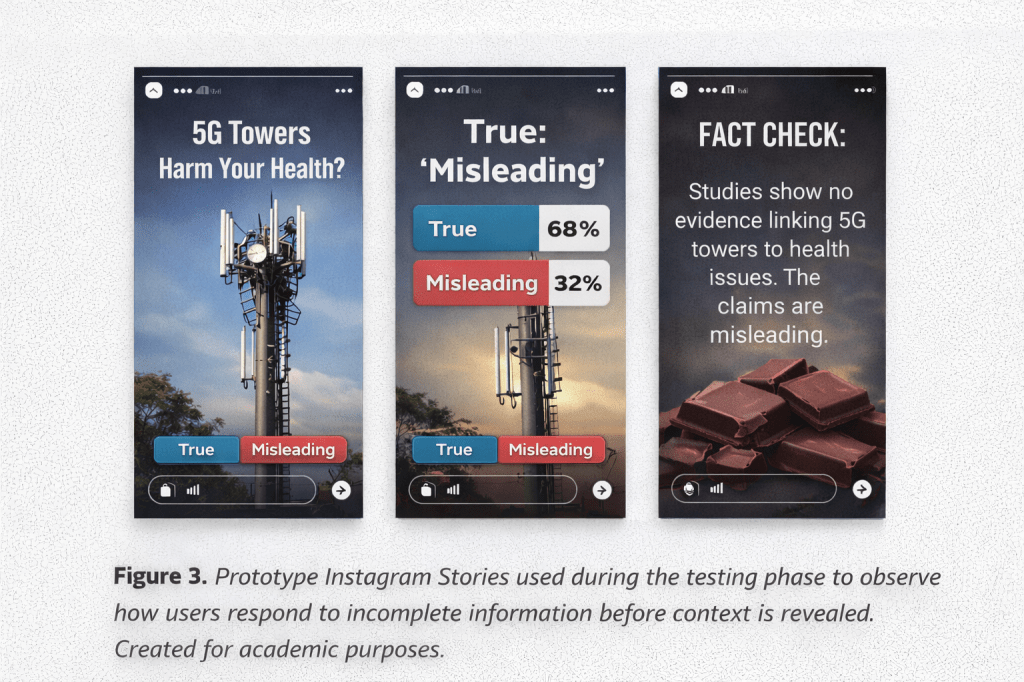
Importantly, the Instagram poll is not the campaign itself, but a testing and prototyping phase. It functions as a method for observing how quickly belief forms when audiences are presented with partial information. Rather than slowing the platform as a whole, the poll introduces micro-friction by requiring users to make a decision before receiving clarification. This creates a pause in the moment of belief not in the speed of the system itself.
This distinction is central to how the campaign works. Social media systems are designed for speed and continuous engagement, making it unrealistic to fully “slow down” the platform. Instead, Context Please. works within existing constraints, using engagement tools that platforms already reward, such as polls, taps, and time spent viewing content. In this way, engagement is redirected toward reflection rather than instant acceptance or sharing.
The pause created by the campaign is therefore cognitive rather than temporal. It occurs when users realise that their confidence was based on incomplete information, highlighting how easily belief can be shaped by networked visibility.
Beyond Instagram, the campaign extends into posters and billboards placed in schools, universities, and public spaces. These materials present bold headlines, images, or statistics without context, mimicking the way misinformation often appears in everyday information environments. Additional elements, such as QR codes or secondary panels, reveal the missing context and link back to the campaign’s core message. Unlike the poll-based prototype, these physical interventions do not rely on interactivity, but instead on delayed clarification and recognition.
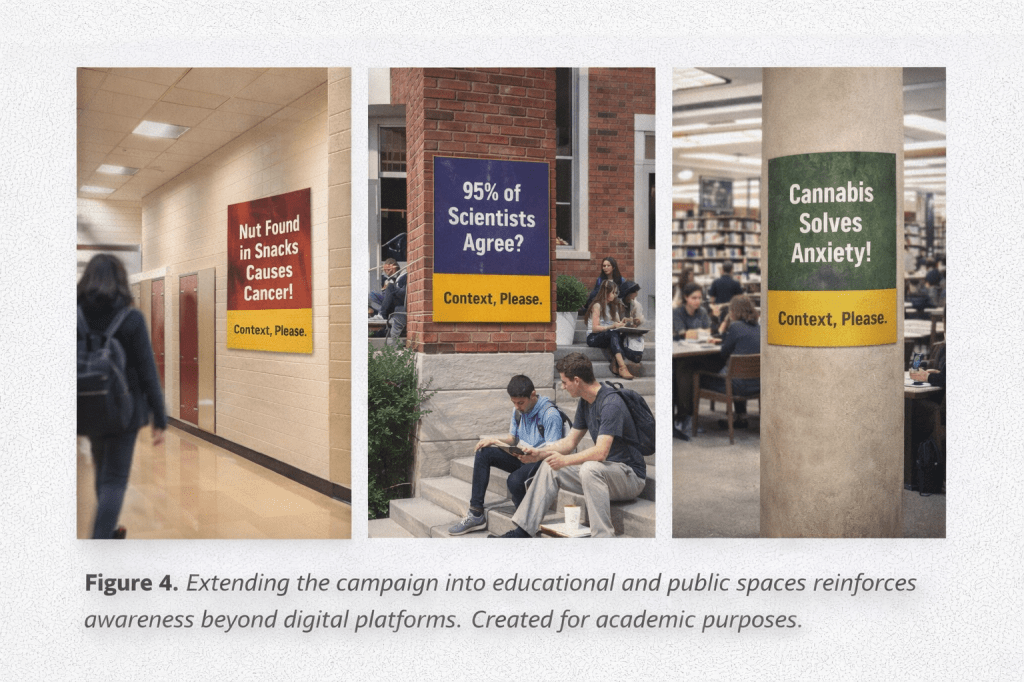
This approach is informed by Marshall McLuhan’s idea that “the medium is the message,” which argues that the structure of a medium shapes how information is understood more than content alone (McLuhan, 1964). Whether encountered on a phone screen or a billboard, isolated and decontextualised information carries persuasive power simply through its visibility and placement.
The project is also influenced by Byung-Chul Han’s critique of contemporary information societies. Han argues that environments driven by transparency and constant information flow prioritise speed and visibility at the expense of depth and trust, resulting in shallow understanding rather than informed judgment (Han, 2015). Context Please. responds to this condition by deliberately revealing what is missing, rather than adding more information to an already saturated system.
External research supports this networked approach. Wardle and Derakhshan (2017) describe misinformation as a product of complex information ecosystems, while Vosoughi, Roy, and Aral (2018) demonstrate that false information spreads faster than accurate information due to how social networks amplify novelty and emotion. These findings reinforce the project’s position that misinformation is not primarily a user failure, but a consequence of network design.
https://www.aljazeera.com/video/the-stream/2025/9/30/why-does-misinformation-spread-faster-than-truth: Context Please Designing a Networked Response to MisinformationThe social value of Context Please. lies in its emphasis on awareness rather than control. The campaign does not attempt to eliminate misinformation or override platform systems. Instead, it encourages audiences to recognise patterns of framing and first-impression bias. By operating across both digital and physical networks, the campaign reinforces reflective media habits over time rather than relying on a single moment of interruption.
In future stages, the campaign can be refined by testing different levels of misinformation, from subtle framing to overt clickbait, and analysing audience responses during the prototyping phase. This iterative approach allows the project to remain adaptable while maintaining its core objective: demonstrating how networked systems shape belief.
Overall, Context, Please. positions misinformation as a network problem requiring a network-aware response. My contribution to the project was developing a concept that acknowledges the limits of platform design while inserting small, meaningful interventions within it. By shifting the pause from the system to the moment of belief, the campaign offers a realistic and critical response to misinformation in networked media environments.
References
boyd, danah. It’s Complicated: The Social Lives of Networked Teens. Yale University Press, 2014.
Han, Byung-Chul. The Transparency Society. Translated by Erik Butler, Stanford University Press, 2015.
McLuhan, Marshall. Understanding Media: The Extensions of Man. McGraw-Hill, 1964.
Vosoughi, Soroush, Deb Roy, and Sinan Aral. “The spread of true and false news online.” science 359.6380 (2018): 1146-1151.
Wardle, Claire, and Hossein Derakhshan. Information disorder: Toward an interdisciplinary framework for research and policymaking. Vol. 27. Strasbourg: Council of Europe, 2017.
 making media